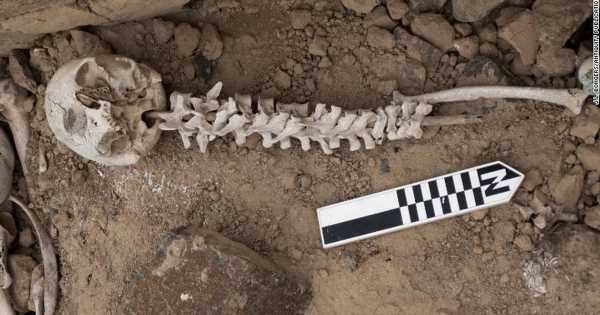
Almost 200 human spines have been found threaded into reed posts in a valley in Peru in an incredibly morbid discovery.
The spines were found in a mass indigenous grave in the Chincha Valley and are thought to date back to the 1500s when European colonisers reached South America and decimated the local populations.
They had been carefully syphoned off and were threaded onto posts in a skewer like fashion.
Researchers found that the majority of the 192 spines found belonged to a single individual and remarked that the peculiar form of burial had never been documented before.

They also found that in most cases the people chosen for the gruesome ritual were children and young adults.
However, there is a school of thought that the bodies were first buried whole and only threaded around reeds after death due to looting.
When European colonisers came to South America, the Inca population was decimated and its kingdoms fell into ruin with grave looting rife.

The study found through Radiocarbon dating that in many cases the threading of the spine onto the reed posts occurred after the initial burial of the bodies.
This implies the graves had been lotted to be stripped off their valuables, decimating their sacredness.
Jacob L. Bongers, who was lead author of the study published in Antiquity magazine, said: "Looting of indigenous graves was widespread across the Chincha Valley in the colonial period.


Young mum stripped naked in park and beaten to death 'with sticks and stones'


"Looting was primarily intended to remove grave goods made of gold and silver and would have gone hand in hand with European efforts to eradicate indigenous religious practices and funerary customs.
"These 'vertebrae-on-posts' were likely made to reconstruct the dead in response to grave looting.
"Our findings suggest that vertebrae-on-posts represent a direct, ritualized, and indigenous response to European colonialism."
To stay up to date with all the latest news, make sure you sign up to one of our newsletters here.
Source: Read Full Article